Utility Knives: An essential tool for precision cutting

For professional users, a utility knife is a basic hand tool that must combine precision, durability, and safety. It is often known as a utility knife, box cutter, snap-off knife, or simply a work knife.
Although it appears to be a simple hand tool, optimal use depends on choosing the right knife type, high-uality blades, and the correct cutting technique. Below, we reveal how to select the right universal knife, what types exist, how to extend its lifespan, and why POPAR utility knives are the ideal choice for professional use.
What exactly is a utility knife?
A utility knife is a cutting hand tool designed for precise cutting of a wide range of materials – from cardboard, paperboard, and wallpaper to rubber, plastic, films, insulation boards, or thin wood veneers.
Its versatility comes from replaceable or snap-off blades, which allow quick adaptation of the tool to different materials and cutting requirements.
For professionals, this means saving time, improved safety, and cleaner cutting results – which makes a significant difference in industry, construction, and maintenance work.
Why do we also call it an “Olfa knife”?
In Slovenia and many other countries, the term “Olfa knife” is commonly used for utility knives. This name comes from the company OLFA, which introduced the snap-off blade. Over time, the term became widely used as a generic expression.
Did you know?
The founder of OLFA, Yoshio Okada, got the idea for the snap-off blade from chocolate bars and observing broken glass fragments. He noticed how chocolate breaks cleanly along segments and how fractured glass creates a sharp, clean edge.
Today, “Olfa knife” is used generically, much like “Flex” for angle grinders, “Teflon” for non-stick coating, or “Radenska” for sparkling water. So when we hear “Olfa knife,” it usually refers not to a specific brand, but to any utility knife with a snap-off or replaceable blade.
Main types of utility knives
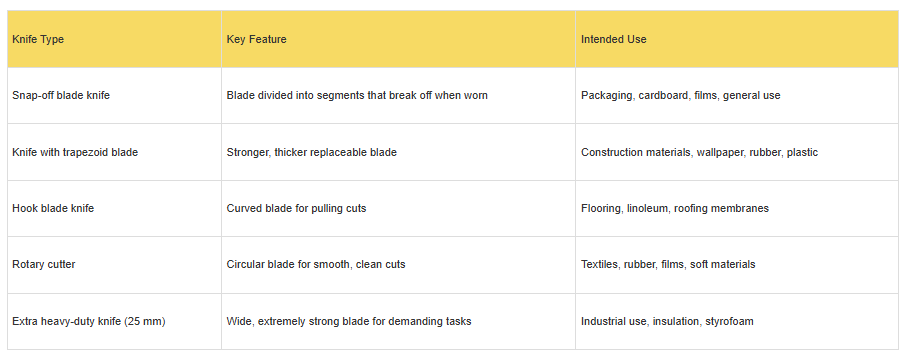
POPAR offers most of the commonly used universal knife types, along with matching blades, so every user can find the ideal tool for their specific tasks.
Materials and construction of utility knives
A professional knife must combine strength and comfort. That’s why POPAR knives feature metal or reinforced plastic/metal handles that ensure a stable grip even during extended use. The blades are made from high-carbon steel, providing long-lasting sharpness and reducing the need for frequent replacements.
Key Advantages of specific POPAR utility knife models:
- precise locking mechanism preventing blade slip,
- ergonomic handles for safe, fatigue-free work,
- one-handed blade replacement,
- wide selection of models to match work requirements.
- every detail is designed for safe, efficient, and long-lasting use in professional environments.
- most replacement blades for POPAR utility knives are SK4 quality.
- SK4 is a designation for high-carbon steel, known for its excellent wear resistance and suitability for frequent or professional use.
- Blades made from SK4 steel usually offer very good sharpness and cutting durability.
- Since high-carbon steel can be more sensitive to corrosion than stainless steel, proper maintenance is essential.
Maintenance and proper storage of knives
To ensure long service life and safe operation, follow these basic rules:
- Replace blades regularly or snap off worn segments. A dull blade requires more force, increasing the risk of slipping and injury.
- Store the knife in the closed position with the blade retracted.
- Clean the blade and housing after cutting sticky materials or cardboard – adhesives reduce cutting precision.
- Store in a dry environment to prevent corrosion of metal parts.
- Check the locking mechanism – if it doesn’t move smoothly, lubricate it lightly with technical oil.
- With proper maintenance, POPAR utility knives retain precision and performance over long periods - reducing tool replacement costs in professional settings.
You can read more about tool maintenance in our blog post: Maintaining Hand Tools: A Complete Guide to Extending Their Lifespan.
Safety tips for professional use
- Always cut away from your body and keep the workpiece on a stable surface.
- Extend the blade only as much as needed, depending on material thickness.
- Do not use damaged or bent blades.
- Use cutting mats when working on sensitive surfaces.
- Dispose of blades safely – use designated containers or packaging, never throw them loosely into the trash.
All POPAR utility knife models are designed with user safety in mind – reliable locking, stable blade guides, and high-quality materials minimize risks even during demanding tasks.
A utility knife is more than a simple tool – it is a precise and reliable assistant in every workshop, warehouse, or installation environment.
By choosing a POPAR utility knife, you choose proven quality, dependable construction, and long service life, supported by a full range of replacement blades.
Explore the full range of POPAR utility knives in the list below and choose the model that best suits your needs.


