Types of screwdriver bits – A practical guide
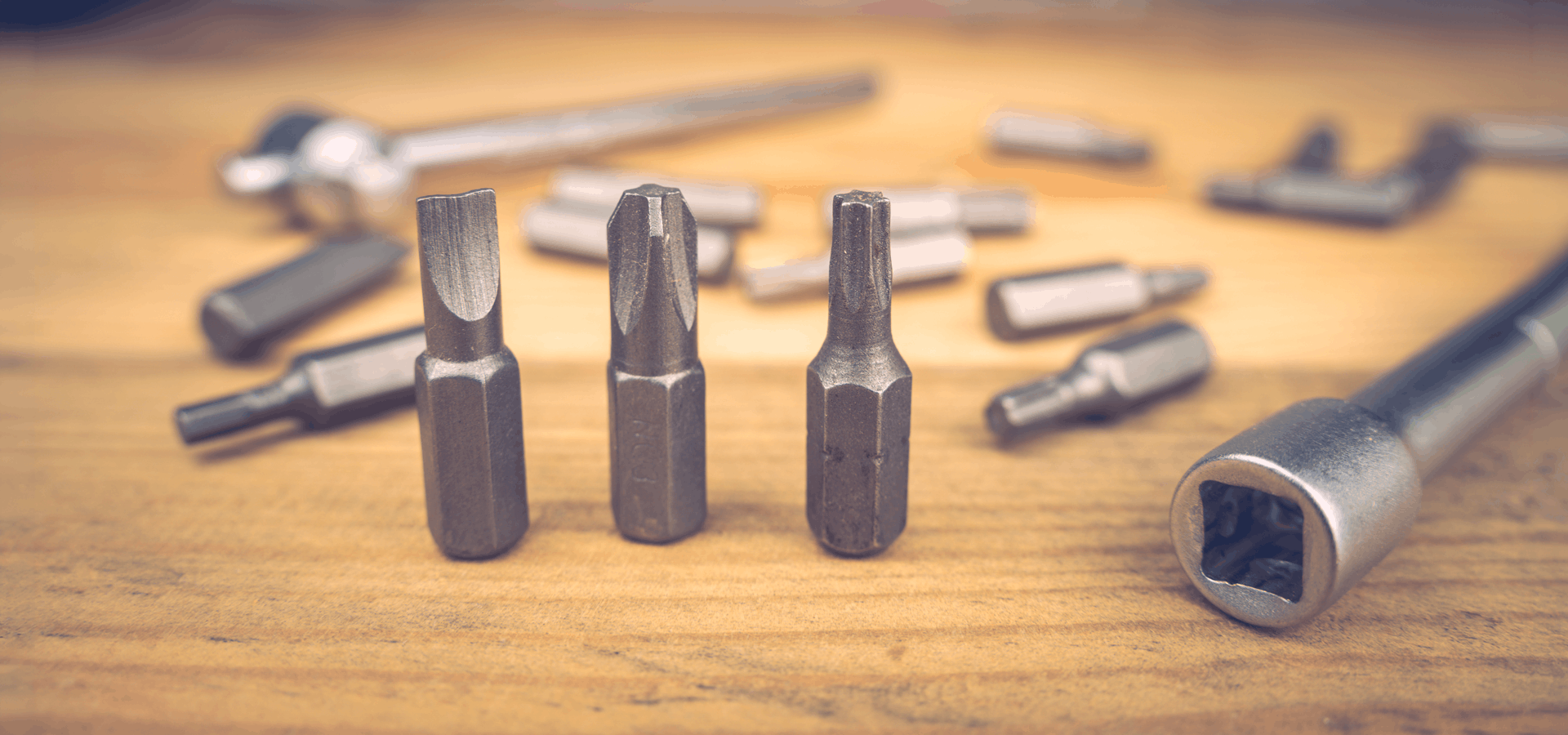
Screwing may seem like a simple operation at first glance, but in reality it represents one of the key mechanical interactions between a tool and a material. At the moment of contact between the bit and the screw, force is concentrated and transmitted through a relatively small contact surface. This is why the shape of the bit, its size, and its material determine whether torque will be transferred efficiently—or whether it will turn into slipping, wear, and damage to the material and/or tool.
In a professional environment, this is not just a matter of aesthetics or precision, but something that directly impacts costs, work time, and even safety.
Development of screw types: From simplicity to optimization
The oldest screw profile—the slotted drive (SL)—was designed at a time when screw manufacturing was limited to basic machining processes. Its advantage was simplicity, but it quickly proved to have a serious design flaw: contact between the bit and the screw occurs along a single line. This results in highly localized stress and a tendency to slip.
This issue led to the development of cross-head designs in the early 20th century. The Phillips (PH) drive was designed to enable faster work, especially in industrial production. At the time—though less understood today—it was intentionally designed to “cam out” (slip) when excessive torque is applied.
Later development, particularly in Europe, introduced the Pozidriv (PZ) drive, which improved torque transmission with additional contact surfaces—essentially an upgraded cross-head design. This is why Pozidriv is now the standard in the furniture industry rather than Phillips. Incorrect substitution between these two profiles leads to rapid wear and screw damage.
The biggest leap in screw drive development is the star-shaped Torx (TX) system, where contact is distributed over a larger surface area. The result is significantly better torque transfer and near elimination of slipping. This is why Torx systems dominate in the automotive industry and structural applications today.
Why bits actually slip
To understand bit selection, it’s crucial to understand contact physics. Each profile has:
- a contact surface (how much material actually transmits force),
- a force transmission angle (whether the force pushes the bit out or keeps it stable),
- tolerance between the bit and the screw.
With slotted bits (SL), force is applied at an angle that creates an upward component—pushing the bit out. With Torx (TX), force is almost radial, meaning the bit remains stable even under high torque.
This is also why modern wood and construction screws rarely use the basic Phillips (PH) drive anymore.
Hex (Allen) and internal drives: Advantage in tight spaces
The hex (Allen) screw system follows a different logic. It is less about preventing slip and more about enabling torque transfer in confined spaces. The internal hex allows:
- fastening without an external head,
- more aesthetic and compact joints,
- use in mechanical engineering and precision mechanics.
However, in practice, hex systems have a drawback: contact stresses are high, making screws sensitive to edge wear if the bit does not fit perfectly.
Bit Materials
In professional use, the difference between bits is not just in shape, but especially in material. The most commonly used materials are:
- S2 tool steel – high hardness and resistance to torsional stress
- Chrome-vanadium (Cr-V) – slightly softer but more impact-resistant
The key difference becomes apparent with impact drivers. In these tools, bits are exposed not only to rotational torque but also to impulse loads. That’s why high-quality bits include a so-called torsion zone, which acts as a stress absorber.
Such bits are often included in professional sets, like the POPAR 32-piece screwdriver bit set, where a combination of different profiles allows work across various materials and applications.
The role of holders and magnetization in precision work
An often overlooked part of the screwing system is not the bit itself, but the bit holder. A magnetic holder stabilizes the screw and reduces the need for manual support, which is crucial when working overhead or in hard-to-reach areas.
A good example is the POPAR magnetic bit holder, which allows the use of standard bits while improving precision and work speed.
Choosing the right bit
In practice, most mistakes happen when selecting the size. The bit must completely fill the screw profile—without play, but also without force when inserting.
However, size is not the only factor. It is also important to consider:
- profile compatibility (a Phillips bit should not replace a Pozidriv bit, even if it seems to fit),
- bit length (deep screws require longer bits or extensions),
- tool type (manual screwdriver, drill driver, or impact driver).
For manual work, classic screwdrivers are often used, such as those found in POPAR screwdriver sets, where handle ergonomics and a magnetic tip play an important role in precision work.
Common mistakes in practice – and why they happen
The most common mistake is not using the wrong tool—but using a worn-out one. Bit edges become rounded over time, reducing the contact surface. The result is:
- increased localized stress,
- faster slipping,
- permanent screw damage.
Another common mistake is mixing standards—especially Phillips and Pozidriv bits. Although they look similar, their geometry differs, leading to uneven force transfer and rapid wear.
Although choosing a bit may seem simple, it is actually about optimizing a mechanical system. Every contact between a bit and a screw is a compromise between:
- geometry,
- material,
- torque,
- and working conditions.
Professional practice does not allow improvisation. The right choice means less damage, greater efficiency, and a longer tool lifespan—confirmed by both expert sources and industry practice.