Why doesn't a knife cut anymore? Blade geometry, materials, and tool wear
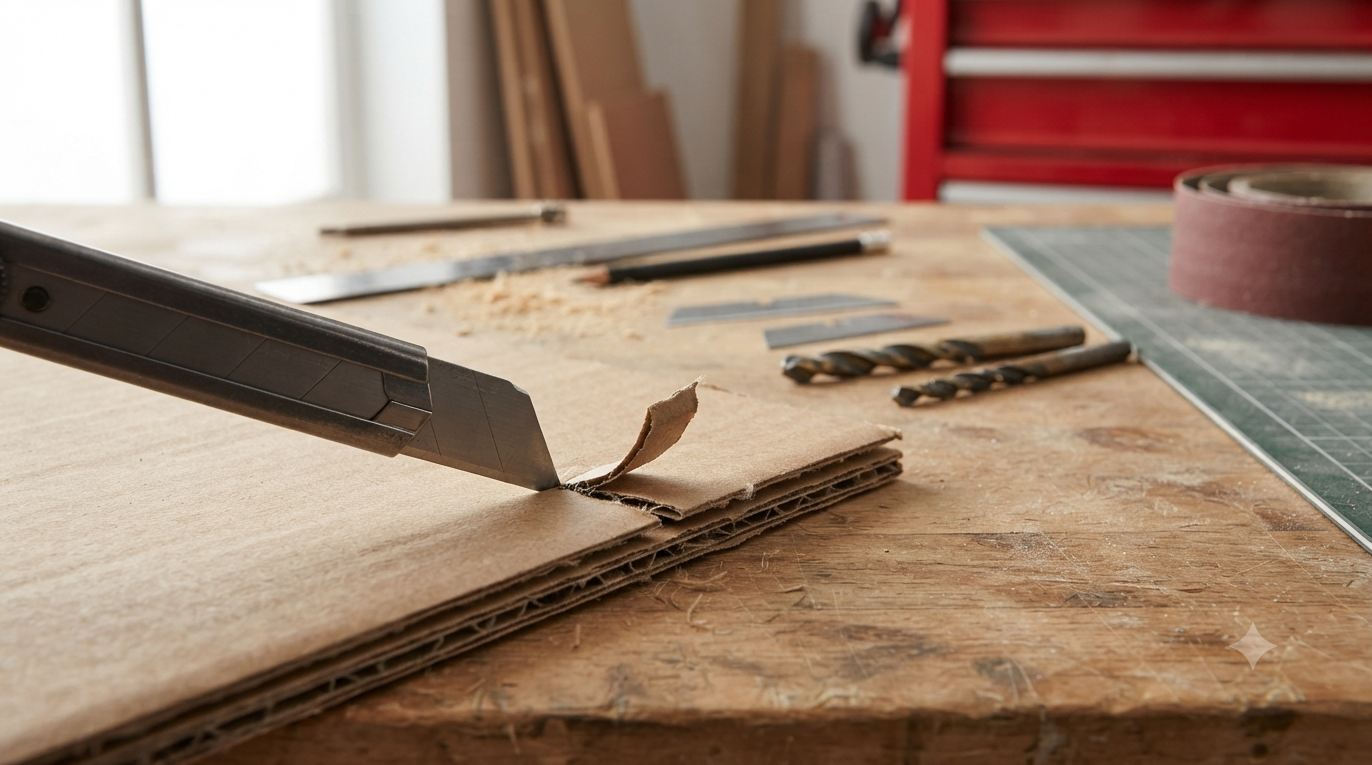
Anyone who has ever tried cutting cardboard with a dull utility knife knows that the difference between "it cuts" and "it doesn't cut" is never accidental.
Hand tools cut because of the combination of three key factors: blade geometry, the material the blade is made from, and the degree of wear the cutting edge has already experienced. In practice, this means that the same utility knife, drill bit, or cutting disc can perform exceptionally well—or extremely poorly—depending on how it was sharpened, what material it is made of, and how much it has already been used.
In this article, we explain what happens at the cutting edge, why some tools stay sharp longer than others, and how understanding blade geometry and materials can help you choose the right tool—whether you're working with a utility knife, a cutting disc, or a drill bit.
Why doesn't a knife cut anymore?
The most common reasons are:
- A worn cutting edge
- An incorrect sharpening angle
- An unsuitable blade material
- Corrosion
- Using the blade on the wrong material
What does it actually mean for a tool to "cut"?
Cutting is a mechanical process in which the blade concentrates force onto an extremely small area until that force exceeds the strength of the material being cut. It is important to understand that a blade does not simply "slice through" material instantly. Instead, it locally deforms the material until it fails.
Blade sharpness is essentially determined by the radius of the cutting edge. The smaller this radius, the smaller the area over which the force is distributed, and the less force is required to achieve the same cutting effect.
As the blade becomes dull, this radius increases. In practice, this means significantly more force is needed to make the same cut, increasing the risk of the tool slipping, producing uneven cuts, and damaging the workpiece.
This is also why a dull tool is often more dangerous than a sharp one. The user instinctively applies more pressure, while overall control of the tool decreases.
Blade Geometry: The Angles That Determine Everything
The geometry of a cutting edge consists of several angles that few users know by name, even though they directly determine how a tool behaves on a particular material.
The rake angle is the angle between the front face of the blade and the direction of the cut. A smaller rake angle produces a more aggressive cut but reduces durability, while a larger angle provides greater control at the expense of cutting speed. This is why knives designed for paper or precision craft work typically have a sharper tip angle than general-purpose utility knives intended for cardboard or insulation boards.
Equally important is the edge angle, which is the angle between the front and back faces of the blade. A very sharp edge angle (typically 15–20°) produces exceptionally clean cuts in soft materials but is easily damaged by hard or abrasive surfaces. A larger edge angle (25–35°) is less aggressive but significantly more resistant to wear and microscopic chipping.
This is why woodworking chisels have a sharper bevel angle than metalworking chisels, where durability is more important than achieving the smoothest possible cut.
For drilling tools, geometry also includes the point angle, which determines how the drill bit initially bites into the material, and the helix angle, which influences how efficiently chips are removed. Drilling wood requires a completely different point geometry than drilling steel or concrete because each material fractures and evacuates chips in a different way.
If you'd like to learn how to choose the right drill bit for different materials, read our blog about the broader POPAR hand tool range, where the basic categories of tools for various applications are presented.
Why the same cutting angle doesn't work for every material
It is important to understand that there is no universally "best" sharpening angle.
Soft materials such as paper, cardboard, or thin plastic film require an extremely sharp, aggressive cutting edge because they primarily resist shear forces. Harder and more abrasive materials, such as composite panels, fiberglass, or reinforced cardboard—quickly wear down a thin cutting edge, making a more robust blade geometry the better choice.
This is why manufacturers offer different blade types for utility knives instead of a single "universal" blade for every application.
Blade materials: What makes some blades last longer?
Blade geometry determines how a blade cuts, while the blade material determines how long it can continue cutting effectively before wearing out.
Modern hand tool blades are typically manufactured from several major categories of materials, each with its own advantages and trade-offs.
Carbon tool steel (such as SK4 or SK5 grades commonly used in snap-off utility knife blades) allows extremely precise grinding at fine edge angles, producing exceptional sharpness. The downside is greater susceptibility to corrosion and slightly lower heat resistance compared to alloy steels.
This is why it is important to regularly snap off worn segments—or replace the blade entirely—when using a utility knife with breakaway blades. Doing so exposes a fresh, razor-sharp edge without requiring resharpening.
High-speed steel (HSS) is the standard material for drill bits and milling cutters because it retains its hardness even at the elevated temperatures generated during drilling. Cobalt-alloyed HSS (HSS-E) offers even greater heat resistance, making it particularly suitable for stainless steel and other hard metals.
Carbide (tungsten carbide) cutting edges go one step further. They are exceptionally hard but also more brittle, making them ideal for masonry and concrete drill bits, where wear resistance is more important than flexibility.


For grinding and cutting tools such as flap discs and cutting discs, there is no cutting edge in the traditional sense. Instead, its function is performed by abrasive grains—typically aluminum oxide, zirconia alumina, or ceramic abrasive—bonded to a backing material. The same principle applies here as with blades: a more aggressive abrasive grain removes material faster but also wears out more quickly, while harder, slower-cutting abrasives offer significantly longer service life in demanding professional applications.
To learn more about cutting disc materials and how to choose the right one for your application, read our guide to cutting discs. If your work mainly involves material removal using flap discs, see our blog Flap Discs: Construction, Materials, and Choosing the Right One.
Tool wear: What happens to the cutting edge at the microscopic level?
Tool wear is not a single phenomenon but rather the combined result of several wear mechanisms acting simultaneously, each progressing at a different rate depending on the material being processed and the way the tool is used.
Abrasive wear occurs when hard particles within the workpiece—such as sand in concrete or mineral fillers in certain plastics—literally grind away the cutting edge, much like sandpaper. This type of wear is gradual and uniform. Over time, the cutting edge becomes rounded, the edge radius increases, and the tool eventually loses its ability to produce clean cuts.
Micro-chipping is a different mechanism. It refers to tiny, often invisible pieces breaking away from the cutting edge due to localized impact loads or excessive brittleness caused by an overly narrow edge angle. This phenomenon is common in over-hardened or insufficiently tough blades and explains why professional tool manufacturers always strive to balance hardness (abrasion resistance) with toughness (resistance to brittle fracture).
Thermal wear is the third major mechanism and is particularly important during drilling and metal cutting. Friction between the tool and the workpiece generates heat that can locally exceed the tempering temperature of the steel. When this happens, the cutting edge loses its hardened microstructure and begins wearing rapidly, even if it was originally extremely hard. This is why intensive metal drilling should be carried out with proper lubrication or coolant and in short intervals rather than by applying continuous pressure.
Corrosion is an indirect but often underestimated contributor to tool wear. Moisture and oxygen cause rust to form on improperly stored tools, damaging the cutting edge long before significant mechanical wear occurs. For this reason, storing tools correctly—for example, in an organized tool trolley—is not simply a matter of workshop organization but has a direct impact on blade life and overall tool performance.
How blade geometry and material influence tool selection
Understanding blade geometry and materials has direct practical value when choosing the right tool for a specific application.
For cutting cardboard, plastic films, or insulation boards, a snap-off utility knife is usually the best choice because it provides quick access to a fresh, sharp edge without requiring sharpening.
For metalworking, where both cutting precision and heat resistance are important, tools made from alloy steel or fitted with carbide cutting edges offer better performance.
For aggressive material removal—such as weld cleaning or rust removal—a coarse-grit flap disc or cutting disc is the most effective solution. Fine finishing work, however, is best performed using finer abrasive grits that produce a smoother surface.
At first glance, fastening and stapling may seem unrelated to cutting, but they rely on the same fundamental mechanical principle: force is concentrated over a very small contact area. The difference is that instead of creating a cut, the force is used to penetrate or secure the material. If you're interested in the broader mechanics of how tools interact with materials, read our article on manual and heavy-duty staplers, where this principle is explained through fastening applications.
How to extend the service life of cutting tools
The lifespan of a cutting tool depends not only on the quality of its material but also on how it is used.
Regularly replacing worn blades or snapping off dull blade segments is a quick and inexpensive way to restore the original sharpness of snap-off utility knives.
When drilling, always adjust the drilling speed and feed pressure to suit the material. Excessively high speeds in hard metals accelerate thermal wear, while speeds that are too low increase the mechanical load on the drill tip.
When using abrasive discs, allow the disc to do the work instead of applying excessive pressure. This extends disc life while also improving the quality of the finished surface.
Proper storage is equally important. Moisture, dirt, and loosely mixed tools inside a drawer accelerate both corrosion and mechanical damage to cutting edges. An organized storage system is therefore more than a matter of convenience—it is a direct investment in longer tool life.
Key takeaways
- Blade sharpness depends on more than just the blade material.
- Blade geometry plays an equally important role.
- A dull blade is often more dangerous than a sharp one.
- Different materials require different cutting angles.
- Proper use and storage significantly extend tool life.
References
- ASM International. (1990). ASM Handbook, Volume 16: Machining. ASM International.
- Trent, E. M., & Wright, P. K. (2000). Metal Cutting (4th Edition). Butterworth-Heinemann.
- Sandvik Coromant. Metal Cutting Technology & Knowledge Center.
- Machinery's Handbook (31st Edition). Industrial Press.
- ISO 8688-1:1989. Tool Life Testing in Milling – Part 1: Face Milling. International Organization for Standardization (ISO).
- Callister, W. D., & Rethwisch, D. G. Materials Science and Engineering: An Introduction. Wiley.
Frequently Asked Questions (FAQ)
Why does my utility knife blade or drill bit become dull so quickly, even though I don't use it very often?
Rapid edge wear is often caused by using the wrong blade material or sharpening angle for the material being cut rather than by frequent use. Cutting abrasive or reinforced materials with a blade that is too soft or has an excessively acute edge accelerates wear, even during occasional use. Corrosion can also contribute if the tool is not dried and stored properly after use.
Can I sharpen a dull utility knife blade myself, or should I replace it?
Traditional cutting tools such as knives, chisels, and scissors can be sharpened at home, provided the original edge angle is maintained and a suitable sharpening stone is used. However, with snap-off utility knife blades or carbide-tipped drill bits, replacing the blade or snapping off the worn blade segment is usually easier, more economical, and produces better results than attempting to sharpen them by hand.
How do I know which drill bit or cutting disc is suitable for the material I'm working with?
The basic rule is that the tool must always be harder than the material being processed. For wood, use a brad-point drill bit. For metal, choose an HSS or carbide drill bit. For concrete and masonry, use a carbide-tipped masonry bit together with hammer drilling. The same principle applies to abrasive discs: coarse grits are intended for rapid material removal, while finer grits are designed for finishing and surface preparation.