Drill bits for woodworking
Drilling into wood is one of the oldest forms of mechanical material processing. Thousands of years ago, craftsmen used simple hand tools to create openings in wood, while the first major development of modern drill bits began in the 19th century with the advancement of spiral geometries and improved steel types. Interestingly, many of the basic shapes of wood drill bits have not fundamentally changed to this day. What has changed are the materials, grinding precision, and torque transfer methods—but the core idea remains the same: to remove wood as quickly, cleanly, and safely as possible.
Today, both professionals and DIY users most commonly rely on four basic types of wood drill bits: the classic wood drill bit, the Lewis auger bit, the formwork drill bit, and the hinge bit (also known as a Forstner bit). Each has a completely different cutting geometry, purpose, and requirements in terms of drilling tools and speed. Choosing the wrong bit often results in torn wood fibers, inaccurate holes, overheating, or even tool damage.
Many users don’t realize that when drilling wood, the geometry of the drill bit is often more important than the power of the drill itself. Even a high-performance professional drill cannot produce a quality hole if the wrong type of bit is used.
Why are wood drill bits different from metal drill bits?
Wood drill bits typically feature a central guide point that allows precise positioning without slipping on the material surface. In addition, they have outer cutting spurs that first slice through the wood fibers before removing material from inside the hole. The result is cleaner edges, less splintering, and faster drilling.
Metal drill bits usually do not have such a point, as it would quickly wear out when working with metal. Metal is also much harder, and such a tip would not penetrate effectively. Wood, on the other hand, is a fibrous material where cutting direction is crucial, while for metal, resistance to heat is the key factor.
High-quality wood drill bits are most commonly made from chrome-vanadium steel (CrV), offering a good balance of hardness, wear resistance, and flexibility. In some professional applications, HSS (High Speed Steel) is also used, especially for longer bits and more demanding tasks where higher temperatures occur.
Wood drill bit
The classic wood drill bit is the most common and versatile choice for woodworking. It is used in furniture assembly, carpentry, solid wood processing, MDF boards, plywood, and chipboard materials. Thanks to its central point, it allows very precise positioning, while the spiral flutes efficiently remove chips from the hole.
In everyday use, sizes between 3 and 12 mm are most common. Smaller diameters are mainly used for pre-drilling for screws, while larger ones are used for wooden dowels, assembly joints, and installation passages. Interestingly, the 8 mm diameter is one of the most widely used in carpentry, as it matches standard wooden dowels (often called “dowels” or “dibels”).
Many users overlook the importance of proper chip removal during drilling. For deeper holes, it is recommended to periodically pull the bit out to reduce heat, improve chip evacuation, and extend the life of the cutting edges. Overheated bits lose sharpness quickly and can cause wood darkening or even burning.
POPAR offers high-quality spiral wood drill bits suitable for both professional and home use, featuring precisely ground cutting edges and durable steel for cleaner cuts and longer lifespan.
Lewis auger bit
The Lewis auger bit—also known as a “ship auger,” “carpenter’s bit,” or simply “auger bit”—is designed for fast drilling of deep holes in solid wood. Its most distinctive feature is its pronounced spiral shape, which enables rapid chip removal while creating a self-feeding effect.
This means the bit pulls itself into the wood, requiring significantly less pressure from the user compared to standard bits. This makes it especially popular among carpenters, installers of wooden structures, roofers, and timber construction professionals.
Common sizes range from 10 to 25 mm, ideal for drilling through beams for electrical installations, structural screws, or pipe passages. Larger diameters (above 30 mm) are used in heavy timber construction and prefabricated wooden buildings.
Improper use can generate strong kickback torque. Due to the aggressive spiral geometry, the bit can suddenly “grab” the material at high speeds, causing the drill to twist abruptly. Professionals therefore use lower speeds, more powerful drills, and often a side handle for better control.
POPAR Lewis auger bits are designed for demanding professional use, offering fast drilling in both soft and hard wood, with precision-milled spirals and robust hex shanks for better torque transfer.
Formwork drill bit
The formwork drill bit is specifically designed for long drilling through wooden formwork panels, multilayer materials, and various construction elements. Its main feature is its extended length, allowing drilling through thick materials without needing to drill from both sides.
It is most commonly used in construction, formwork assembly, wooden substructures, façade systems, and carpentry work. Due to its length, the bit must be rigid enough to prevent bending or vibration during drilling. Many professional models use HEX (hexagonal) or SDS shanks, as standard cylindrical shanks may slip under heavy loads. This is especially important for longer bits where forces are significantly higher. Interestingly, many installers also use formwork bits for alignment and centering, as their long and stable geometry allows very precise guidance through materials.
POPAR formwork drill bits are made from high-quality chrome-vanadium steel and are designed for demanding construction and installation conditions.
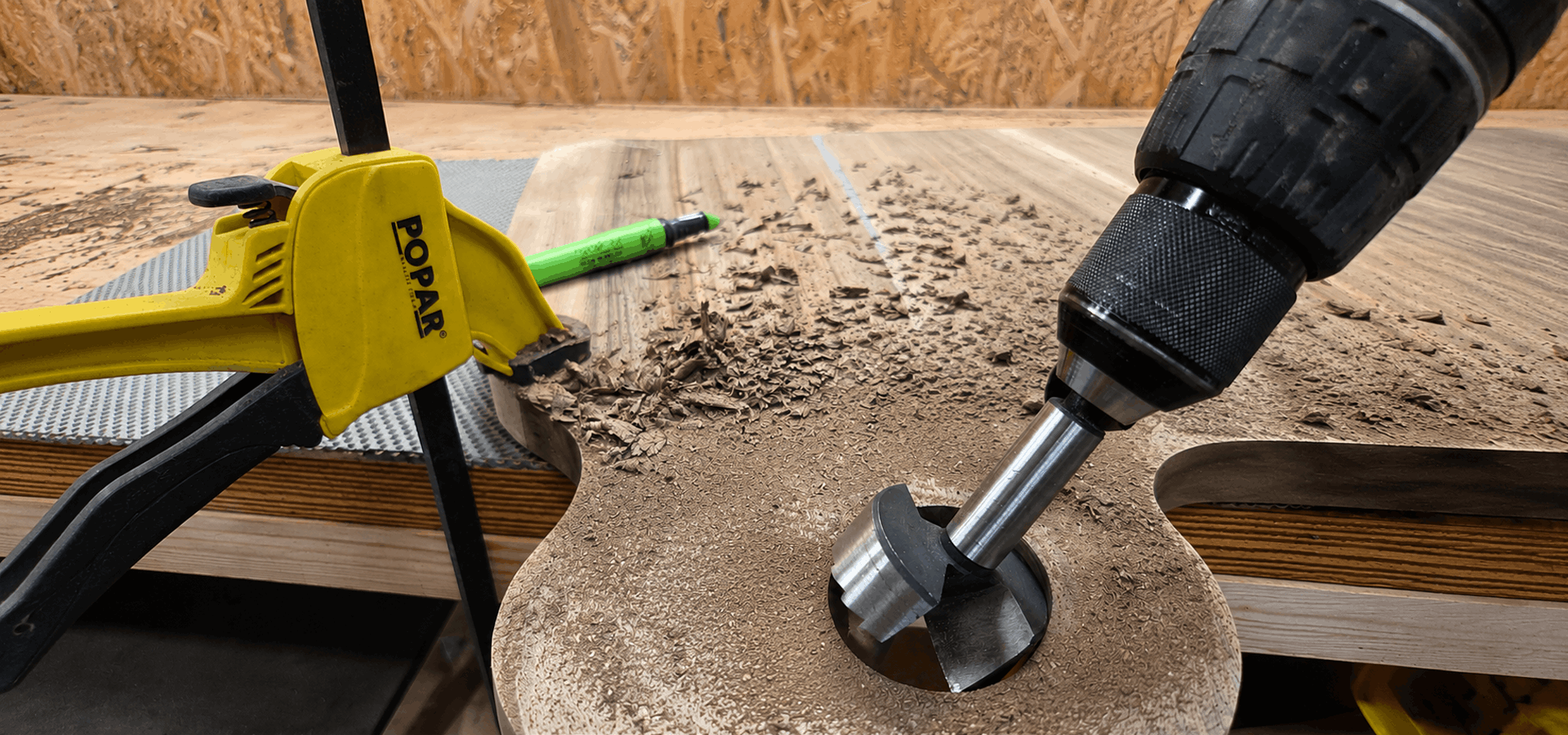
Hinge bit (Forstner bit)
The hinge bit, commonly known as a Forstner bit, is used for creating flat-bottom, precise holes for furniture hardware—especially concealed hinges. Its main advantage is the ability to drill flat-bottom holes without breaking through the material.
Unlike standard spiral bits, a Forstner bit removes material more gradually, cutting cleanly along the perimeter of the hole. This results in extremely clean edges, which is crucial for laminated boards, chipboard, kitchen furniture, and other visible elements.
The most common size is 35 mm, which is the European standard for furniture hinges. Other common sizes include 26 mm and 40 mm for various hardware types.
Many users don’t know that Forstner bits can also drill partial holes at the edge of a material—something that is nearly impossible with standard drill bits. This makes them essential for custom furniture production.
How to choose the right wood drill bit
Choosing the right wood drill bit mainly depends on the type of work you plan to do. For general use and assembly, a classic spiral wood bit is the best choice. For deep drilling in solid wood, a Lewis auger bit is far more efficient, while for long construction holes, a formwork bit is more suitable. For furniture making and hardware installation, there is almost no substitute for a high-quality Forstner bit.
The type of wood also plays an important role. Softer woods allow faster drilling with less wear, while hardwoods require higher-quality steel, sharper edges, and lower speeds. A simple rule used by professionals: the larger the drill bit diameter, the lower the drilling speed should be.
A high-quality drill bit does not just mean faster work—it also ensures greater safety, more precise holes, less material damage, and a longer tool lifespan. That’s why professionals always choose drill bits based on the actual application, not just price or diameter.