Cutting disc or cut-off wheel: Materials, technology, and proper selection
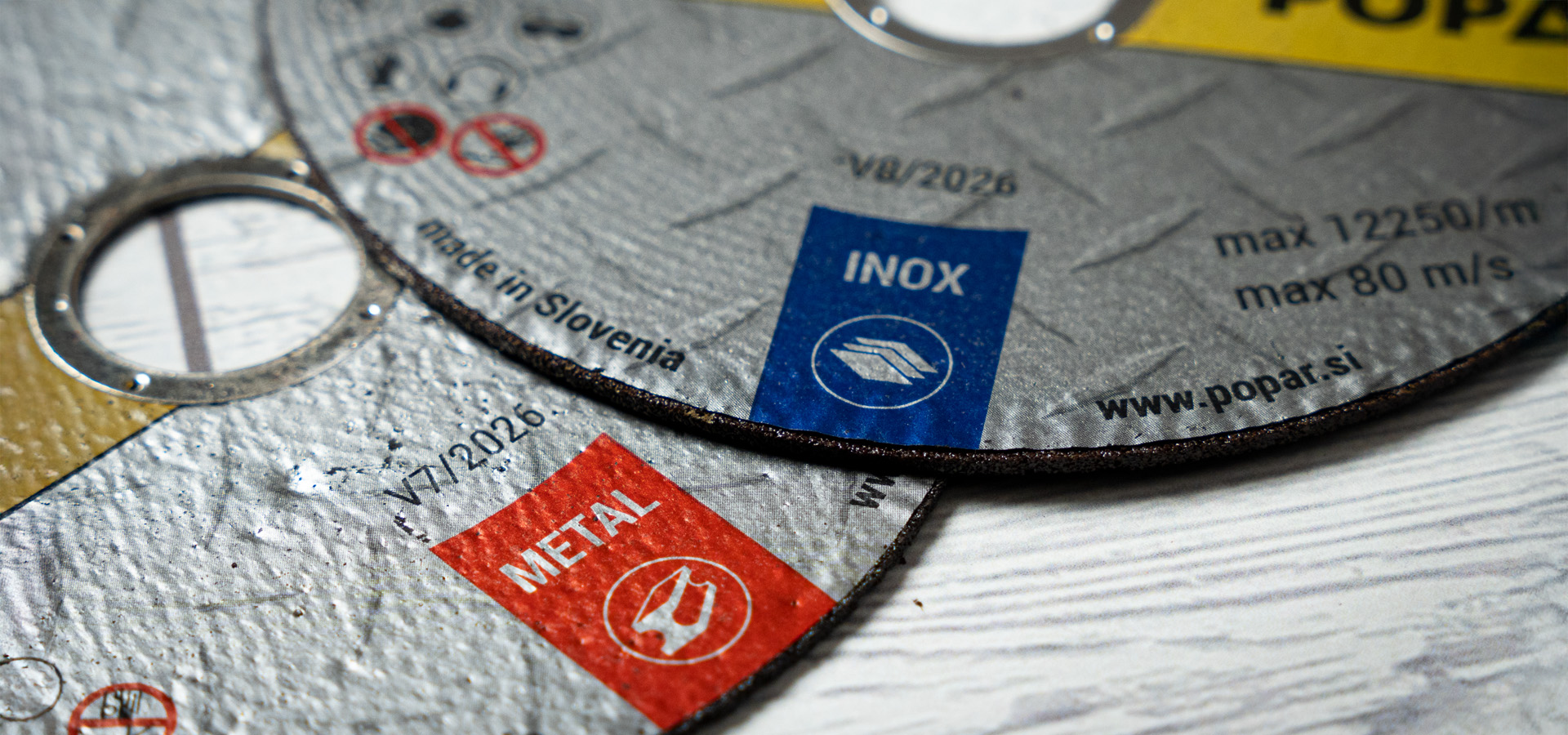
Cutting discs are among the most frequently used – yet at the same time most underestimated – components of handheld and stationary tools. They are often treated as consumables with little difference between products, but the reality is quite different. Differences in materials, construction, thickness, and compliance with standards directly affect cutting speed, cut quality, tool wear, and – most importantly – user safety.
To understand why there are such major differences between individual cutting discs, we must first understand how a cutting disc actually cuts.
How a cutting disc actually cuts material
A cutting disc does not slice material like a toothed blade; instead, it removes material gradually through abrasion. At high rotational speeds (often between 10,000 and 13,000 rpm on angle grinders), abrasive grains at the edge of the disc dig into the material and tear out microscopic particles. This process generates heat, sparks, and wear on both the disc and the workpiece.
A key concept that professionals understand – but amateurs often do not – is so-called self-sharpening.
A high-quality cutting disc is not designed to be as “hard” as possible, but rather precisely balanced: when the top layer of grains becomes dull, the bonding agent must wear away in a controlled manner to expose new, sharp grains. This balance between bond hardness and abrasive type is where the greatest differences between discs lie.
Cutting disc materials
The most common traditional cutting discs for metal are made from aluminum oxide (Al₂O₃). This abrasive offers a good balance between sharpness, lifespan, and price, making it suitable for structural and carbon steels.
When cutting stainless steel (INOX), however, basic aluminum oxide is often less effective, as it generates more heat, which can lead to overheating and structural changes in the material.
For more demanding applications, zirconia-alumina or ceramic abrasives are used. These withstand higher temperatures and maintain sharpness longer. Although more expensive, they are often economically justified in professional use, as they enable faster cutting and reduced wear, resulting in fewer replacements.
For an entirely different class of materials – concrete, stone, ceramics, and asphalt – diamond cutting blades are used. In these tools, cutting is no longer based on classical abrasion but on industrial diamonds bonded within a metal matrix. The segmented or continuous rim design determines whether the cut is more aggressive or cleaner, which is crucial both in construction work and in precision cutting of ceramics and stone.
POPAR offers both classic abrasive cutting discs and various types of diamond blades, enabling a wide selection depending on the material and application.
Cutting disc thickness – Why thinner us not always better
One of the most common myths about cutting discs is that thinner is always better. It is true that thin discs (0.8–1.0 mm) allow very fast cuts with minimal material loss and reduced tool load. This makes them ideal for thin pipes, sheet metal, and installation work.
However, thin discs also have limitations. They are more sensitive to lateral forces, require a steadier hand, and are not suitable for rough or deep cuts in solid profiles. For such applications, thicker discs (1.6–2.5 mm) are still used, as they provide greater mechanical stability and vibration resistance.
Professionals typically choose based on a compromise between speed, precision, and robustness – not solely on thickness, but also on disc material and rated speed.
Cutting disc shape – Why geometry is not accidental
When discussing cutting discs, we often focus on material, thickness, and diameter, but much less on shape. In practice, however, the geometry of the disc significantly influences cutting behavior, stability, accessibility to the workpiece, and safety. Shape is not an aesthetic decision but the result of mechanical stresses occurring at high peripheral speeds.
In professional use, we distinguish three basic geometric types: flat cutting discs, depressed-center (concave) cutting discs, and diamond blades with a metal core.
Flat cutting disc (Type 41)
The flat cutting disc is the classic and most widespread form of abrasive cutting disc. Its entire surface lies in one plane, without indentations around the mounting area.
This shape allows direct and linear force transfer into the cutting zone, resulting in uniform pressure across the full thickness of the edge. Flat discs are therefore ideal for precise, controlled cuts, especially in thinner materials such as sheet metal, small-diameter pipes, and profiles.
Their limitation appears in confined spaces or deeper cuts, as the flat design does not provide additional clearance between the angle grinder housing and the workpiece. They also require accurate alignment, as they are more sensitive to lateral loads if the cutting angle changes mid-cut.
Flat cutting discs (Type 41) are standard for precision metalwork and are commonly included in the POPAR range for metal and stainless steel, where clean cuts and control are emphasized.
Depressed-center cutting disc (Type 42)
Depressed-center cutting discs feature a slightly recessed area around the bore, meaning the cutting edge is positioned slightly forward relative to the mounting flange.
This design provides better accessibility – the user can cut deeper or closer to the material surface without the grinder housing or flange interfering. It also offers improved stability at the start of the cut, allowing smoother entry into the material.
Type 42 discs are often used in construction, installation work, and cutting thicker metal elements, where ergonomics and speed are as important as precision.
However, the concave shape does not mean the disc is suitable for side grinding. Despite its more robust appearance, it is still designed exclusively for radial loads in the direction of the cut.
Diamond blades with metal core
Diamond cutting blades represent a completely different construction concept. Instead of a homogeneous bonded abrasive, they have a steel core with a welded or sintered cutting rim containing industrial diamonds.
The rim can be:
- Segmented, allowing better cooling and more aggressive cutting,
- Continuous, for cleaner cuts suitable for ceramics,
- Turbo, offering a compromise between speed and precision.
The metal core ensures exceptional stability, even in larger diameters and when cutting very hard materials such as reinforced concrete, granite, or natural stone. Unlike abrasive discs, diamond blades wear through controlled erosion of the metal matrix, which gradually exposes new diamond crystals.
Due to this design, diamond blades are not suitable for conventional metal cutting (with rare exceptions), but they are indispensable in construction and stoneworking. POPAR offers several diamond blade types adapted for dry or wet cutting and various construction materials.
Standards and safety – No room for compromise
A cutting disc rotates at peripheral speeds of up to 80 m/s. Any structural defect, weak bond, or insufficient reinforcement can cause the disc to disintegrate, posing serious danger to the user.
In the European Union, the mandatory standard is EN 12413, which defines requirements for:
- mechanical strength,
- fiberglass reinforcement,
- labeling,
- permitted peripheral speed,
- product traceability.
Additionally, there is the Organization for the Safety of Abrasives (oSa®) certification, representing an additional level of quality and safety control.
Proper selection in practice
Choosing the right cutting disc always begins with the question: what am I cutting and under what conditions?
Material, workpiece thickness, tool power, and frequency of use are key factors. Incorrect selection often results in slow cutting, excessive sparking, overheating, or even disc damage.
It is also important to understand that a cutting disc is not a universal tool. A disc designed for steel is not suitable for stainless steel, and an abrasive disc should not be used on concrete. Professionals are well aware of this, while such mistakes are more common among DIY users.
Maintenance and storage – An overlooked factor in service life
Even the highest-quality cutting disc can become dangerous if stored improperly. Moisture, temperature fluctuations, and mechanical damage can affect the resin bond and reinforcing fibers. Discs should therefore be stored in a dry place, laid flat, protected from moisture and direct sunlight.
A visual inspection before each use is recommended. Any crack, layer separation, or uneven edge is a clear sign that the disc must no longer be used – regardless of how much abrasive material remains.
POPAR cutting discs in professional use
Each POPAR cutting disc is designed with professional use in mind. The range includes:
- thin cutting discs for precision metal cutting,
- more robust discs for demanding applications,
- diamond blades for concrete, masonry, and ceramics.
Strong emphasis is placed on compliance with standards, clear labeling, and adaptation to real working conditions in the field. This combination of technical accuracy and practical usability is why POPAR discs are becoming a reliable choice in many professional environments.
A cutting disc is not merely a consumable item, but a precision tool in which every component – from abrasive type to thickness and compliance standard – plays a role. Understanding these principles enables safer work, better results, and lower long-term costs.
For both DIY users and professionals, the same rule applies: choosing the right cutting disc is not a cost, but an investment in quality, efficiency, and safety.
Sources
EN 12413 – Safety requirements for bonded abrasive products
Organization for the Safety of Abrasives (oSa®)
POPAR – Key Certifications for Cutting & Grinding Discs in the EU


