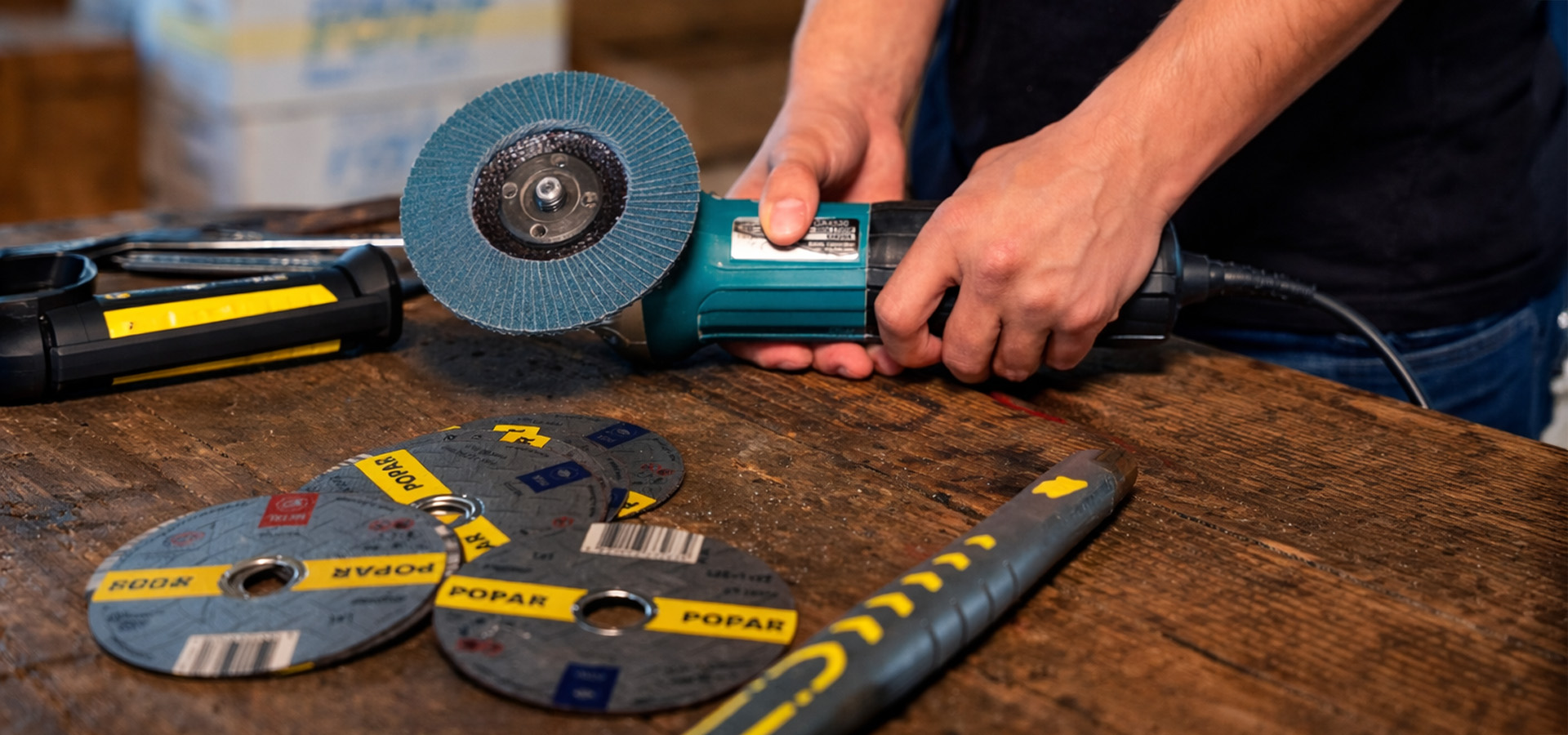
Flap discs are today one of the most versatile tools for processing steel, stainless steel, aluminum, and other materials. Despite their widespread use, their technical design, the differences between individual types, and the impact of proper selection on the final result are often underestimated. In practice, a flap disc is frequently regarded merely as a compromise between a grinding wheel and sandpaper, but in reality it is a precisely engineered tool in which the type of abrasive, backing plate, flap arrangement, grit size, and working angle play a decisive role.
Understanding these factors directly affects processing speed, surface quality, disc lifespan, and—last but not least - user safety.
How does a flap disc actually process material?
Unlike a conventional grinding wheel with a homogeneous abrasive surface, a flap disc processes material through the overlapping of multiple individual flaps made of abrasive cloth. These flaps are arranged radially around a backing plate and gradually wear down during operation.
At high speeds (typically up to 13,300 rpm for a 125 mm disc), only part of the flaps come into contact with the workpiece. As the outer abrasive layer wears away, a new, sharper surface is exposed. This process enables:
- Even wear
- Consistent cutting performance
- Better control over material removal
The key advantage of a flap disc is the combination of aggressive material removal and controlled grinding, allowing operations that would otherwise require multiple different discs to be performed with a single tool.
Abrasive materials in flap discs
Aluminum Oxide (Al₂O₃)
- Properties: A universal abrasive with a good balance between sharpness, lifespan, and cost.
- Application: Carbon and structural steels, general metalworking.
- Limitations: On stainless steel (INOX), flaps may clog more quickly due to the material’s high strength and the limited heat resistance of aluminum oxide.
Zirconia Alumina (ZrO₂)
- Properties: Tough, hard, and resistant to high temperatures; maintains sharpness longer.
- Application: Stainless steel, thicker materials, intensive professional use.
- Advantages: Higher grinding speed, longer lifespan, reduced pressure required during operation.
Ceramic abrasives
- Properties: Extremely hard grains with controlled fracturing (self-sharpening effect).
- Application: High-alloy steels, industrial production, intensive professional grinding.
- Note: More expensive, therefore less suitable for hobby users.
Mixed-naterial discs
Some flap discs contain a blend of Al₂O₃ and ZrO₂, enabling versatile use and a good balance between grinding speed and service life.
Backing plate: Plastic or fiberglass
Often overlooked but crucial, the backing plate is the element to which the flaps are attached.
- Plastic backing is lighter, enables quieter operation, and is suitable for fine finishing and lighter loads.
- Fiberglass-reinforced backing is significantly more rigid, resistant to high temperatures, and suitable for aggressive grinding and industrial use.
The choice of backing influences disc stability, force transfer, and the level of control during work.
Grit size – The link between speed and surface finish
Grit size determines how much material the disc removes and what the final surface will look like.
- Coarse (P40–P60): Weld removal, rust removal, rough shaping.
- Medium (P80): General grinding, preparation for further processing.
- Fine (P120 and above): Finishing, uniform surface appearance.
Some discs use mixed grits that combine rapid material removal with improved surface finish.
Flap disc shape and working angle
Flat Flap Discs (Type 27)
- Working angle approximately 15–20°.
- Allow more aggressive grinding; ideal for material removal, edge work, and rough shaping.
Conical Flap Discs (Type 29)
- Curved shape provides a larger contact surface.
- Suitable for uniform grinding of larger surfaces, better control, and fewer gouges in the material.
Proper selection of disc geometry directly affects ergonomics, processing quality, and safety.
Standards and safety
Flap discs must comply with the European standard EN 13743, which defines mechanical strength, permissible peripheral speed, marking and traceability requirements, and backing plate reinforcement criteria. An additional safety assurance is the oSa® certification, which indicates regular production monitoring and compliance with the highest safety requirements.
Proper flap disc selection in practice
Correct selection begins with understanding the application in terms of workpiece material, required surface quality, tool power, and usage intensity.
Incorrect selection leads to slower work, overheating, flap clogging, and faster wear.
Storage and inspection before use
Flap discs must be stored in a dry environment, protected from moisture and mechanical damage. Before use, a visual inspection is essential to check for damaged flaps, delaminated backing, or disc deformation. Any such disc must be immediately removed from service.
POPAR flap discs in professional environments
POPAR’s range of flap discs combines various abrasives (Al₂O₃, ZrO₂, ceramic), multiple grit sizes, and different designs, while ensuring compliance with EN 13743. The discs are designed for real working conditions where efficiency and safety are equally important.
A flap disc is not merely a substitute for sandpaper, but a technically advanced tool that combines speed, control, and processing quality. Understanding its design enables better results, fewer mistakes, and greater workplace safety.
For both professionals and DIY users, the same rule applies: choosing the right flap disc is not a cost, but an investment in efficiency and quality of work.
Sources
- EN 13743 Standard
- Organization for the Safety of Abrasives (oSa®)
- FEPA – Federation of European Producers of Abrasives